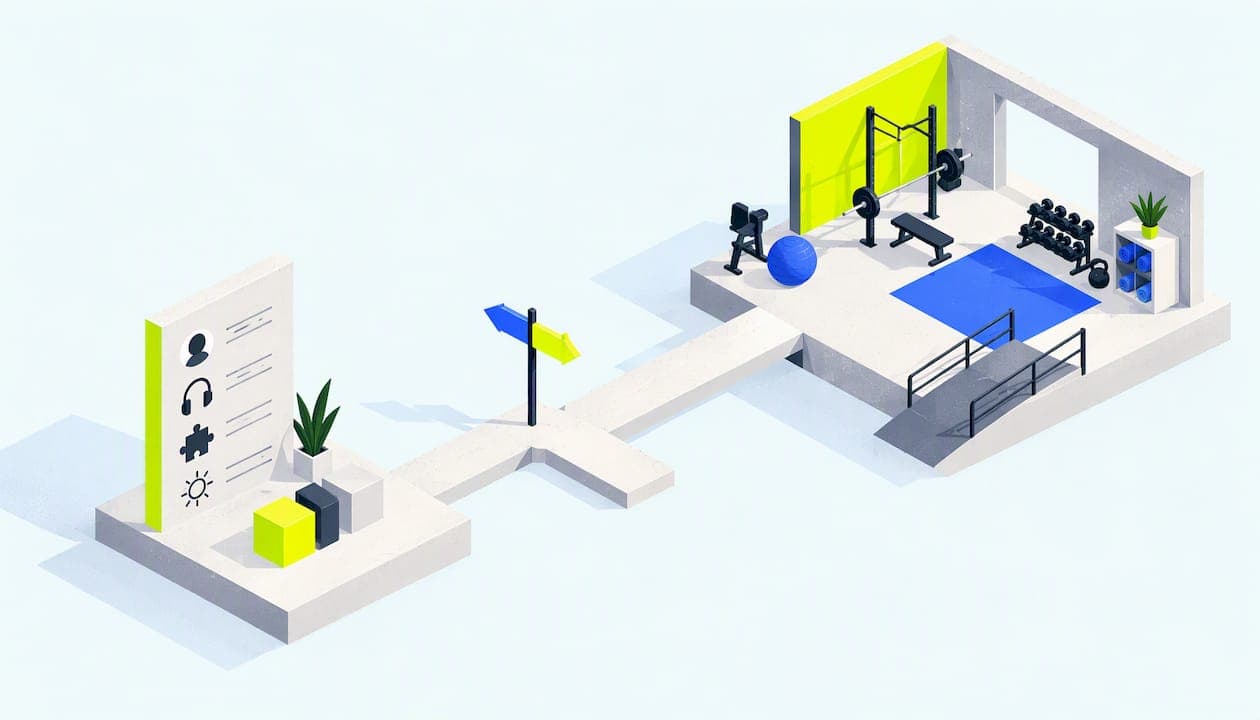
An autism-friendly gym is not a gym with a rainbow-infinity sticker on the door. It is a gym where an autistic person can predict what will happen, control how much sensory input they get, and be coached as an individual instead of being managed. Most of that comes down to three things you can change: the environment, the way staff communicate, and the support around the membership.
This guide is for gym owners, managers and trainers in Australia who want to get it right, and for autistic people and families who want to know what to look for. Many top search results are about children's sensory play centres. This article is about ordinary gyms, studios and leisure centres, and about adults and teens as well as kids.
TL;DR
- Sensory load (noise, light, crowds, surprises) is the biggest barrier you control. Quiet times, lower music and a way to preview the space fix a lot.
- Drop compliance-style coaching. Relationship-led, choice-based sessions work better than strict reps-and-sets scripts.
- A friendly face matters: social support from a coach, mentor or gym partner helps autistic people build routines and keep turning up.
- In Australia, NDIS funding does not pay for a gym membership, but it can fund a support worker or allied health services if they are reasonable and necessary for the participant's plan.
- Staff training is what turns a nice room into a safe one. Look for training co-designed with disabled people.
Table of Contents
- What "autism friendly" actually means in a gym
- The sensory environment: what to change first
- Coaching: from compliance to connection
- People and routine: the social side
- A practical audit for gym owners
- Paying for support: how the NDIS fits in
- Our perspective
- Training your team
- Choosing a gym as an autistic person or family
- FAQ
- Sources
What "autism friendly" actually means in a gym
Autism is a spectrum, so there is no single checklist that suits everyone. One person needs silence and dim lights. Another seeks intense movement and loves a loud playlist. A third communicates without speech. What they share is that unpredictability and sensory overload tend to make a gym hard to use, and that being talked down to makes it worse.
So the working definition we use is simple: an autism-friendly gym gives people information in advance, gives them control in the moment, and treats them as the expert on their own body and sensory needs.
That has a policy side too. Australia's 2025-2035 National Roadmap to Improve the Health and Mental Health of Autistic People points toward autism-affirming, human-centred and trauma-informed care and away from restrictive practices. A gym is not a clinic, but the direction of travel is clear: autonomy and trust over compliance and control. Coaching habits that rely on pushing a client through a script are on the wrong side of that shift.

The sensory environment: what to change first
Gyms are often built to be stimulating: loud music, bright overhead lights, mirrors, clanging plates, unpredictable crowds at 6 am and 5:30 pm. For many autistic people that is exhausting before the first rep. The good news is that you can reduce most of it cheaply.
Sound
- Set a lower default volume, or offer a lower-volume zone or time block.
- Avoid sudden alarms or announcements during quiet blocks, and warn people when a fire drill or class change is coming.
- Offer a quiet room or low-traffic corner where someone can pause without being asked why.
Light and space
- Where you can, dim or switch off harsh lights in one area and keep the quieter corner free of mirrors that flash movement.
- Mark an uncrowded route to the equipment people use most, so they do not have to weave through a busy floor.
- Keep equipment layout consistent. Moving the dumbbell rack without telling anyone is a real disruption for someone who relies on routine.
Previewing the space
Predictability is the most underrated adjustment. City of Sydney Leisure publishes Access Keys, developed with Access Ability Australia, which give a stepped guide to each centre and explain what to expect on arrival. You do not need a council budget to do the same. A page on your website with photos of the entrance, reception, change rooms and main floor, plus a short video walkthrough and a note on your quietest hours, does the job.
A useful test: could someone plan their first visit, down to where they will walk in and where they will stand, without ever speaking to a person? If yes, you have removed a major source of anxiety before they even arrive.
Coaching: from compliance to connection
The environment gets people through the door. The coaching decides whether they stay.
Many traditional training habits are compliance-based: the trainer sets the plan, gives instructions, and the client either follows or is seen as failing. For autistic clients this is often counterproductive. A recent conference abstract on a demand-reduction, relationship-led model for physical activity engagement, from an exercise service supporting neurodiverse young people, describes this alternative approach for people with complex autism presentations: reduce demands, build the relationship first, share control.
In practice that looks like:
- Offer choices, not commands. "Do you want to start with the bike or the rowing machine?" beats "Get on the bike."
- Make the first sessions about rapport. If the first session is a walk around the room and a conversation about what they enjoy, that is a good first session.
- Use visual schedules. A simple card or whiteboard showing the order of exercises reduces the need to process spoken instructions and removes surprise.
- Say what is about to happen. "We will do three sets, then a break, then finish" is useful. Open-ended, shifting sessions are not.
- Let movement be play when that suits the person. Carries, throws, balance games and circuits can build the same capacities as a standard strength block.
- Accept stimming and breaks. Repetitive movement or stepping away is regulation, not misbehavior.
- Ask how they communicate best. Some people prefer text, pictures or written notes ahead of a session.
None of this lowers the standard of your coaching. It is a more accurate form of it: you are matching the programme to the person.
Fitness targets still matter
Being autism friendly does not mean skipping progression. The Australian Government's physical activity recommendations for people with disability (updated March 2026) suggest adults aim for 30 minutes or more of moderate to vigorous activity on most days, muscle-strengthening at least 2 days a week, and functional activities for mobility, balance and coordination at least 3 days a week. They also stress breaking up long periods of sitting. Those are good anchors for programme design, adjusted for the individual's health, preferences and any advice from their doctor or exercise physiologist.

Research suggests autistic adults often do not reach recommended activity levels. A scoping review of physical activity interventions for autistic adults lists benefits such as better sleep, more social connection and less psychological distress, which is why removing barriers is worth the effort.
People and routine: the social side
A quiet room is not enough if nobody there feels safe to talk to. Research on autistic adolescents and young adults, summarised on Matilda, indicates that social support is a critical part of gym participation. Mentors who act as gym partners or friends help participants handle sensory needs, build routines and lower the anxiety that often blocks community exercise.
What this means for a gym:
- Introduce one consistent person. Seeing the same coach or staff member each visit is calming and builds trust.
- Welcome support people. A parent, friend or support worker should be able to come in without friction or extra fees where you can manage it.
- Keep communication literal. Say what you mean, avoid sarcasm in instructions, and skip idioms when giving feedback.
- Build a routine around the visit. Same arrival time, same warm-up, same finish.
A practical audit for gym owners
Use this table to check where your gym stands today. Pick two or three items to fix this month, not all of them at once.
| Area | Starting point | Going further |
|---|---|---|
| Information | Photos and opening hours online | Video walkthrough, quiet-hours schedule, Access Key style guide |
| Sound | Lower music volume on request | Scheduled low-sensory sessions, quiet zone |
| Light | Switch off a lamp bank in one area | Dedicated dimmed room or corner |
| Booking and first visit | Easy contact by text or email | Pre-visit tour outside peak hours |
| Coaching | Offer choices in each session | Visual schedules, relationship-led programming |
| Staff | Brief all staff on sensory needs | Accredited disability inclusion training for the whole team |
| Policy | Written statement of adjustments | Co-designed with autistic and disabled members, reviewed yearly |
What we see again and again is that owners start with the physical changes and stop. The people side is where a gym becomes genuinely welcoming, and it costs the least.
Paying for support: how the NDIS fits in
Cost is often the first question from families and participants, so staff should be able to explain it accurately. In Australia, the NDIS does not fund a gym membership because it is considered a day-to-day living cost. What it can fund, if it is reasonable and necessary and matches the participant's plan, is a support worker who attends the gym with the person, or allied health services such as exercise physiology that tie to disability-related goals; see the NDIS website for current rules.
That distinction matters for how you present your gym. The facility is one thing. The inclusive support needed to use it is another. If you can describe clearly what adjustments you make and what support your coaches provide, participants and their plan managers can make a stronger case for the part that is fundable. Always tell people to check with their planner, support coordinator or plan manager rather than promising what will be approved.
Our perspective
We build training for fitness professionals, and we hear one sentence far too often: "We are welcoming to everyone." Most gyms mean it. Few have tested it with the people they say it to.
Here is what we think after working with disabled people and the professionals who coach them.
First, start with listening. Autistic people have been telling the fitness industry what stops them for years: noise, unpredictability and being treated as a problem to fix. You do not need a perfect space before you start. You need to ask members what would make a visit easier, then change one thing and ask again.
Second, patronising language is a barrier in itself. Calling someone "inspiring" for walking into a gym, or speaking to their support person instead of them, sends the message that they do not belong. We wrote about this in I'm Not Your Inspiration, and That's the Point. Respect is a coaching skill, and it can be taught.
Third, trainers need practical knowledge, not awareness slogans. Knowing how to structure a first session, how to offer choices, how to read a stress response and how the social model of disability changes your programme design is what separates a friendly gym from a safe one. Our courses are co-designed with people with disabilities for that reason.
Finally, the fix is rarely expensive. Quiet hours, a visual schedule and a well-prepared coach do more than a new fit-out.
— Tommy
Training your team
If you want your staff to coach autistic clients with confidence, we offer practical, CPD-accredited online modules for fitness professionals, gym owners and institutions. They are non-patronising and built around real experiences of disabled people.
- Crash Course: Train Clients With Disability: a quick start for trainers who want practical skills now.
- The Social Model of Disability: $40 AUD one-off. It reframes where barriers come from, which changes how you design a space and a programme.
- History of Disability in Australia: $20 AUD one-off. Context for why trust is hard won, and why language matters.
We also offer a free introductory course so you can try our style before you buy anything, and group and team enrolment if you want to train a whole roster together. You can also hear more conversations on the Gone to Fit podcast.
Choosing a gym as an autistic person or family
If you are looking rather than building, try these steps before you sign a contract:
- Check the website. Look for photos, a floor plan or a sensory guide. If there is none, ask for one by email.
- Ask about quiet times. Staff should be able to tell you when the gym is least busy and whether music volume can be adjusted.
- Visit outside peak hours. Walk the route from the door to the equipment you would use and see how it feels.
- Meet the coach. Ask how they adapt sessions. Good answers involve choices, routine and rapport, not just "we treat everybody the same."
- Ask about support people. Find out whether a support worker or friend can come with you.
- Start small. A 15 minute visit that goes well beats a 60 minute one that ends in overload.
Some allied-health-led venues also run purpose-built gym spaces with sensory-friendly features. The Next Step Recovery & Wellness Centre describes one such space, designed for people of all abilities with accessible equipment and a sensory-friendly environment. Options vary by state and city, so ask local disability organisations and exercise physiologists what is available near you.
Industry bodies are moving too. AUSactive reports its All Abilities pilot engaged 375 people with varied disabilities in 10 to 12 week tailored exercise programs during the 2022-2023 reporting period, a sign that structured inclusive programs can reach people the sector has missed.
FAQ
What is an autism-friendly gym?
It is a gym that reduces sensory overload, gives people clear information before they arrive, and coaches them with choice and respect. That can mean quiet hours, lower music, visual schedules and consistent staff. There is no single standard, so the best test is whether autistic members say it works for them.
Can the NDIS pay for an autism-friendly gym membership?
No, the NDIS does not fund gym memberships because they count as day-to-day living costs. It may fund a support worker to attend with you or allied health services such as exercise physiology, if they are reasonable and necessary and fit your plan. Check with your planner, support coordinator or plan manager.
How do I train a client with autism?
Start with rapport, not a hard workout. Ask how they like to communicate, offer choices, use a visual schedule and keep the routine predictable. Adjust one thing at a time and follow their lead. Formal training in disability inclusion helps you do this with more confidence.
Do small gyms need special equipment?
Usually not. The biggest changes are about sound, lighting, information and the way staff communicate. A quiet corner, a page with photos and a clear routine cost far less than new machines.
Is there accredited training for fitness professionals?
Yes. Our courses are CPD accredited, and we offer a free introductory course plus individual and group enrolment. Check any provider's accreditation and ask whether people with disabilities helped design the content.
Sources
- 2025-2035 National Roadmap to Improve the Health and Mental Health of Autistic People
- City of Sydney Leisure: Accessibility and Access Keys
- Exercise in complex autism presentations: a demand-reduction, relationship-led model
- Australian Government: Recommendations for people with disability
- Physical activity interventions for autistic adults: a scoping review
- Social support and gym participation in autistic adolescents and young adults
- NDIS: gym membership is not a funded support
- NDIS
- The Next Step Recovery & Wellness Centre: Gym & Recovery Zone
- AUSactive: All Abilities