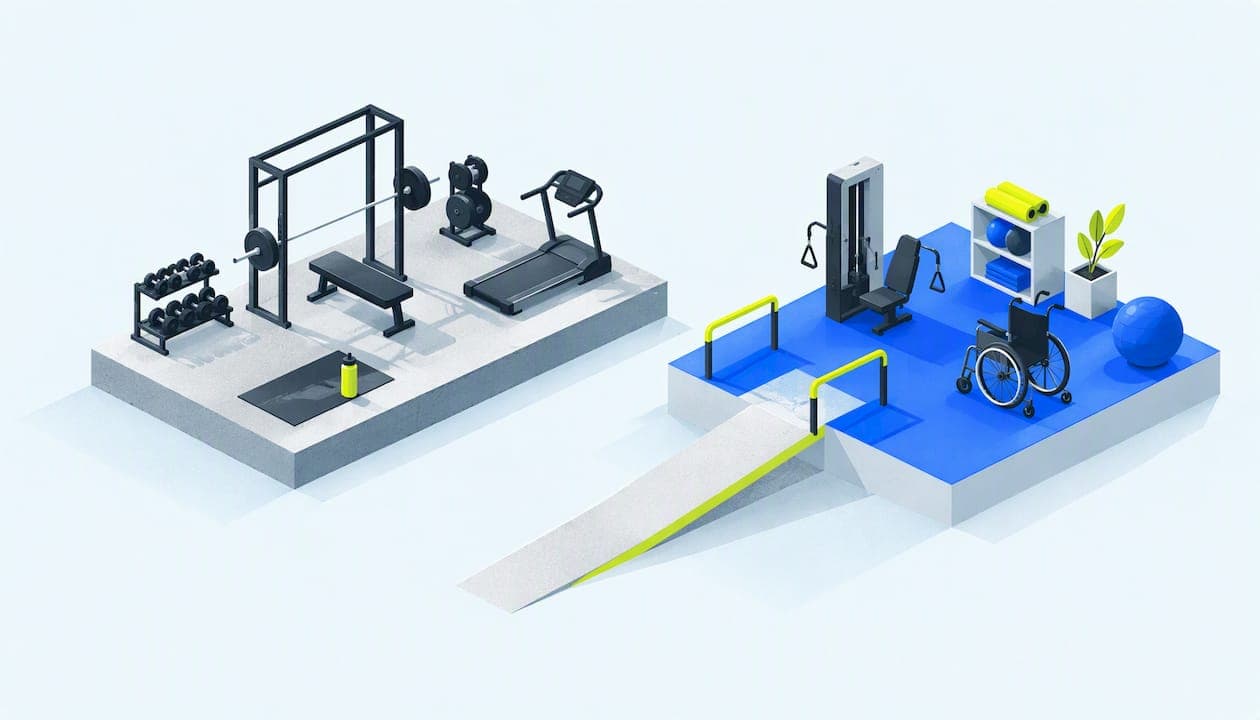
The NDIS does not pay for a gym membership. It can fund supports that make exercise possible and safe for a participant, such as a support worker at the gym, transport there, or sessions with a qualified exercise professional under a capacity building budget. Whether any of that applies to you depends on your plan and on the NDIS reasonable and necessary test.
This guide is for three groups: participants and families working out what to ask for, trainers who want to work with NDIS clients, and gym owners who want their facility to be a place those clients can use. We run inclusive fitness training for the industry, so we cover both sides of the counter.
TL;DR
- Gym memberships are not funded by the NDIS. They count as a day-to-day living cost, not a disability support.
- Supports around exercise can be funded if they link directly to your disability and your plan. Examples are a support worker at the gym, transport, and personal training or exercise physiology under capacity building.
- Trainers working with NDIS clients need disability-specific skills and clear goal reporting. A generic personal training certificate is a starting point, not the finish line.
- Gym owners decide whether an NDIS client has a good experience. Staff knowledge matters more than a ramp and a poster.
- AUSactive professionals can earn CPD points for relevant courses. Ours are CPD accredited, and the first introduction is free.
Table of Contents
- Why the NDIS won't pay for the membership
- What the NDIS can fund around the gym
- Personal training under the NDIS
- What participants can do to get a sensible outcome
- What this means for trainers
- What this means for gym owners
- Can you claim the gym on tax?
- Our perspective
- Build the skills before the client walks in
- FAQ
- Sources
Why the NDIS won't pay for the membership
The NDIS publishes a list of 15 categories of goods and services that are not NDIS supports. Gym membership falls into the group of everyday costs everyone carries, whether or not they have a disability.
The NDIA also publishes a short fact sheet on gym membership, dated 6 May 2025. It uses a case example of a participant who wants to improve his fitness to help manage the effects of his disability. The point of the example is that the goal can be reasonable while the membership itself still isn't funded.
AUSactive says the same thing on its NDIS help page: the NDIS does not fund membership because it is a day-to-day living cost not related to disability support needs. If a participant's goal is to get fit by going to the gym, the NDIS may fund a support or assistive technology that helps them do it, but not the entry fee.
It can feel unfair, because exercise is often recommended for people with disability. The logic is that a membership gives you the same thing it gives anyone else. The funded part is whatever extra you need because of your disability.

What a membership costs, for context
Canstar Blue's survey puts active members' typical spend at about $58 a month, or $720 a year. Members who don't use their membership lose more, an average of $93 a month, or $1,116 a year. If you are paying the membership yourself, that's worth keeping in mind when choosing a gym. A cheaper venue you actually use beats a premium one you don't.
What the NDIS can fund around the gym
The useful question is not "will the NDIS pay for the gym?" but "what does my disability make harder about exercising, and which support addresses that?"
| Need | Possible funded support | Condition |
|---|---|---|
| Help using equipment safely | A support worker who attends the session | Linked to your disability needs and in your plan |
| Getting to the gym | Transport | The NDIA says it may fund this if family or community can't provide it and you can't use public transport independently |
| Building skills, strength, mobility | Personal training or exercise physiology | Usually under capacity building, improved health and wellbeing |
| Equipment or assistive technology | Assessed items | Must meet reasonable and necessary criteria |
The NDIA's own wording is that supports must be directly related to your disability. A generic goal such as "lose weight" or "get fit" will rarely carry a request. A goal such as "build the leg strength to transfer independently" or "manage fatigue so I can work three days a week" connects exercise to function, and that is what planners and reviewers look for.
Does the NDIS fund exercise equipment?
Sometimes, but not as a general fitness purchase. Equipment has to be disability-related and justified as reasonable and necessary, usually with a recommendation from a health professional such as an occupational therapist or exercise physiologist. Standard home gym gear that anyone might buy is treated as an everyday cost. If you are considering equipment, talk to your support coordinator or plan manager before buying, not after.
Personal training under the NDIS
Personal training is the part of this topic with the most search interest, and the most confusion. AUSactive's help desk states that the NDIS funds personal training under capacity building, health and wellbeing when it helps a person with disability improve their fitness. That is a different thing from buying a block of sessions at your local gym.
In practice, disability personal training differs from standard training in a few ways:
- Goals come from function, not appearance. Mobility, independence, pain management, balance, confidence.
- Programs are individualised. They account for diagnosis, medication, fatigue, sensory needs, communication preferences and the participant's own priorities.
- There is documentation. Funded supports usually need progress notes or reports that a plan reviewer can read.
- The trainer knows the limits of their scope. When a participant needs an exercise physiologist or physiotherapist, a good trainer says so and works alongside them.
Exercise physiologist or personal trainer?
Both appear under improved health and wellbeing. Exercise physiologists are allied health professionals and often handle complex conditions, clinical assessments and rehabilitation. Personal trainers typically deliver ongoing training once a safe program exists. Many participants use both. If you have a complex or unstable condition, begin with a clinician's advice before you start a training program, and ask your GP or specialist what is safe for you.

Registered or unregistered providers
What matters is how you manage your plan. Self-managed and plan-managed participants can generally use providers who are not registered with the NDIS, while agency-managed participants must use registered providers. Check your plan management type first, then ask the provider about their registration, qualifications, insurance and how they invoice. Your plan manager or support coordinator can confirm the details.
What participants can do to get a sensible outcome
- Write a function-based goal. Describe what you want to be able to do, not just the exercise.
- Look at your plan. Find out whether you have capacity building funds for improved health and wellbeing, and who manages them.
- Ask a health professional for supporting evidence. A short letter or report connecting exercise to your disability needs helps at plan review.
- Interview the trainer. Ask what disability experience they have, how they adjust sessions, and how they report progress.
- Try a session before committing. Pay attention to whether you are asked what you want, or told what to do.
- Sort out access separately. If you need a support worker or transport, raise it with your support coordinator rather than assuming the gym provides it.
See our blog for what it feels like to be treated as an inspiration rather than a customer. It is the attitude many participants say they run into first.
What this means for trainers
NDIS clients are a real part of the market, but they are not a niche that you can serve with enthusiasm alone. A participant who has been stared at, over-assisted or spoken to like a child at a gym will not return, and their support coordinator will hear about it.
Trainers who do this well tend to share a few habits:
- They ask the client how their body works and what they want, then believe the answer.
- They understand the difference between the medical and social models of disability, and what each means for how they talk and plan.
- They know the funding context well enough to write goals and progress notes in plain, functional language.
- They avoid "inspiration" language and don't praise people for simply turning up.
Structured, evidence-based programs in other sports show how much detail helps. A Singapore swim school's write-up of a 10-week program for autistic children describes small groups, clear progressions and trial lessons. The setting is different, but the principle carries into the gym: predictable structure, small steps and a trial before commitment make participation easier.
CPD for trainers: what counts
AUSactive now calls what used to be CECs CPD points. Per its CPD guidance, AUSactive approved programs earn 1 to 15 points each, and professionals need 20 CPD points per two-year registration cycle to renew as Accredited. A 12-month registration period needs 10 points. In-house training earns 1 point per hour, with a cap of 16 per two years, and self-directed learning earns 1 point per resource, up to 10 per two years.
If you are searching for inclusion points, check the exact points value shown on the course certificate and in the AUSactive listing. AUSactive also stresses that CPD is meant to build real skills, including disability-inclusive practice, not just tick a number. Choose courses that change what you do on the floor on Monday.
What this means for gym owners
Most gyms that want to be inclusive begin with the building: doorways, change rooms, equipment spacing. That's necessary. But when we talk to participants, the bigger barriers are usually people-related: staff who don't know what to say, assumptions about what someone can do, and sales conversations that treat a disability as a liability.
A practical checklist for owners:
- Train front-of-house staff, not only trainers. The first conversation sets the tone.
- Offer a trial visit with a chance to look at the space and equipment before paying.
- Be clear about what you provide. Many NDIS participants bring a support worker. Decide how your policy handles a support worker's entry, and say so on your website.
- Don't brand an "NDIS gym" without substance. Marketing that promises funding you can't deliver erodes trust. Memberships are not funded, and you shouldn't imply they are.
- Ask participants. People with disability will tell you what is wrong with your space if you ask and then act.
The business case is simple, too. A single trained team is a point of difference for local support coordinators, allied health professionals and families who are looking for somewhere dependable to refer people.
Can you claim the gym on tax?
Usually no. The ATO's employee guide treats gym fees and fitness-related expenses as private, except in narrow cases where strenuous physical activity is a regular and essential part of the job, such as for a physical training instructor at a police academy. Keeping fit for ordinary work doesn't qualify. If you are a fitness professional wondering about your own deductions, the ATO's own guidance is the place to start, and a registered tax agent can tell you what applies to your situation.
Our perspective
We built Inclusive-AF because most disability training for fitness professionals is written for the trainer's comfort, not the client's reality. It leans on inspiration, pity and a lot of cautious language. People with disability notice, and they leave.
Funding rules are only one part of what decides whether a participant actually trains. The other part is whether the person at the desk and the person on the floor know what they are doing. We have seen good intentions sit alongside poor practice: a trainer who is kind but doesn't ask, a gym that has a ramp but no one who knows how to talk about access.
So our courses are practical and direct, and they are shaped by people with disability. We cover the history behind today's systems, the social model of disability, and how to train clients with disability in a way that respects them. We would rather you leave a module with one thing to change on Monday than with a feeling of having been educated.
On the NDIS specifically, our advice is to be honest with clients about what is and isn't funded, and then to be excellent at the part that is. If a participant's plan covers training, the most important thing you can do is deliver sessions that are tied to their goals and documented clearly. That's what makes a provider worth rebooking.
— Tommy
Build the skills before the client walks in
If you train, manage or employ people in fitness, our store has three entry points:
- History of Disability in Australia: $20 AUD, one-off.
- The Social Model of Disability: $40 AUD, one-off.
- Crash Course: Train Clients With Disability: a practical introduction, with a free introductory option so you can see our approach before paying.
All of our courses are CPD accredited. For teams, group and team enrolment lets a gym, studio or institution train staff together. You can also hear conversations from the field on our Gone to Fit podcast, or read about one person's experience with Disability Employment Services to see how systems feel from the other side.
FAQ
Can I use my NDIS funding to pay for a gym membership?
No. The NDIS treats gym membership as a day-to-day living cost that is not related to disability support needs. It can fund related supports, such as a support worker at the gym or transport, if they meet the reasonable and necessary criteria and are in your plan.
Does the NDIS pay for personal training?
It can. Personal training is generally funded under capacity building, improved health and wellbeing, when it is connected to your disability needs and goals. Check your plan, your plan management type and the provider's details with your support coordinator or plan manager.
Will the NDIS pay for transport to the gym?
Possibly. The NDIA says transport may be funded if your family or community can't provide it and you aren't able to use public transport independently. It still needs to be justified in your plan.
How many CPD points do fitness professionals need with AUSactive?
AUSactive requires 20 CPD points per two-year registration cycle to renew as Accredited, and 10 points for a 12-month registration period. Approved courses earn between 1 and 15 points each, so check the points value shown for any course you are considering.
Can I claim my gym membership on my tax return?
Almost never. The ATO classes gym fees as private expenses, with a very narrow exception for jobs where strenuous physical activity is a regular and essential duty. Ask a registered tax agent if you think your role might qualify.
Sources
- AUSactive NDIS help desk and FAQs
- NDIS fact sheet: Gym membership (6 May 2025)
- NDIS: Supports that are not NDIS supports
- AUSactive: What is CPD?
- Canstar Blue: Average gym membership prices in Australia
- ATO: Employees guide for work expenses, Part C